💾 Why Version Control Exists: The Pendrive Problem
“If you’ve ever seen a folder named
final_final_v3_really_final, you already understand why version control exists.”
Before Git, before GitHub, before modern collaboration tools—developers survived using pendrives, emails, and blind hope.
This article explains why version control systems were inevitable, using a simple but painfully real analogy: the pendrive problem.
1️⃣ Life Before Version Control (Yes, It Was Chaos)
Imagine this is 2010.
You’re working on a college project or a small startup app.
There is no Git, no GitHub, no collaboration tools.
Your workflow looks like this:
Copy project to a pendrive
Share it with a teammate
Make changes
Copy it back
Pray nothing breaks
📁 Your project folder slowly turns into:
project/
├── final/
├── final_v2/
├── final_latest/
├── final_latest_fixed/
└── final_really_latest/
Sound familiar? 😅
2️⃣ The Pendrive Analogy Explained 💡
Think of a pendrive as manual version control.
What the pendrive tries to do:
Share code
Keep backups
Transfer work between developers
What actually happens:
Someone overwrites someone else’s work
Nobody knows which version is correct
Files get lost
Changes disappear forever

👉 The pendrive had no memory of history.
3️⃣ Problems Developers Faced Before Version Control
Let’s break down the real issues.
❌ 1. Overwriting Each Other’s Code
Two developers. One file.
Dev A updates
main.cppDev B updates the same file
Dev B copies his version last
Dev A’s changes are gone
No warning. No conflict. No recovery.
❌ 2. No History of Changes
Ask this question:
“Why did this bug appear?”
Before version control:
Nobody knows
No record of who changed what
No way to revert safely
Mistakes were permanent.
❌ 3. No Collaboration Timeline
There was no:
Change history
Author tracking
Timestamped edits
Everything depended on memory and communication, which always fails at scale.
❌ 4. Fear of Experimentation
Developers avoided:
Refactoring
Big changes
New ideas
Why?
Because:
“What if I break something and can’t undo it?”
Innovation slowed down.
4️⃣ When Teams Grew, the Problem Exploded 💥
Now imagine:
5 developers
10 developers
100 developers
Everyone editing the same codebase.

Without version control:
Code conflicts increased
Productivity dropped
Bugs multiplied
Trust disappeared
📌 The pendrive model does not scale.
5️⃣ Timeline of Lost Versions 🕒
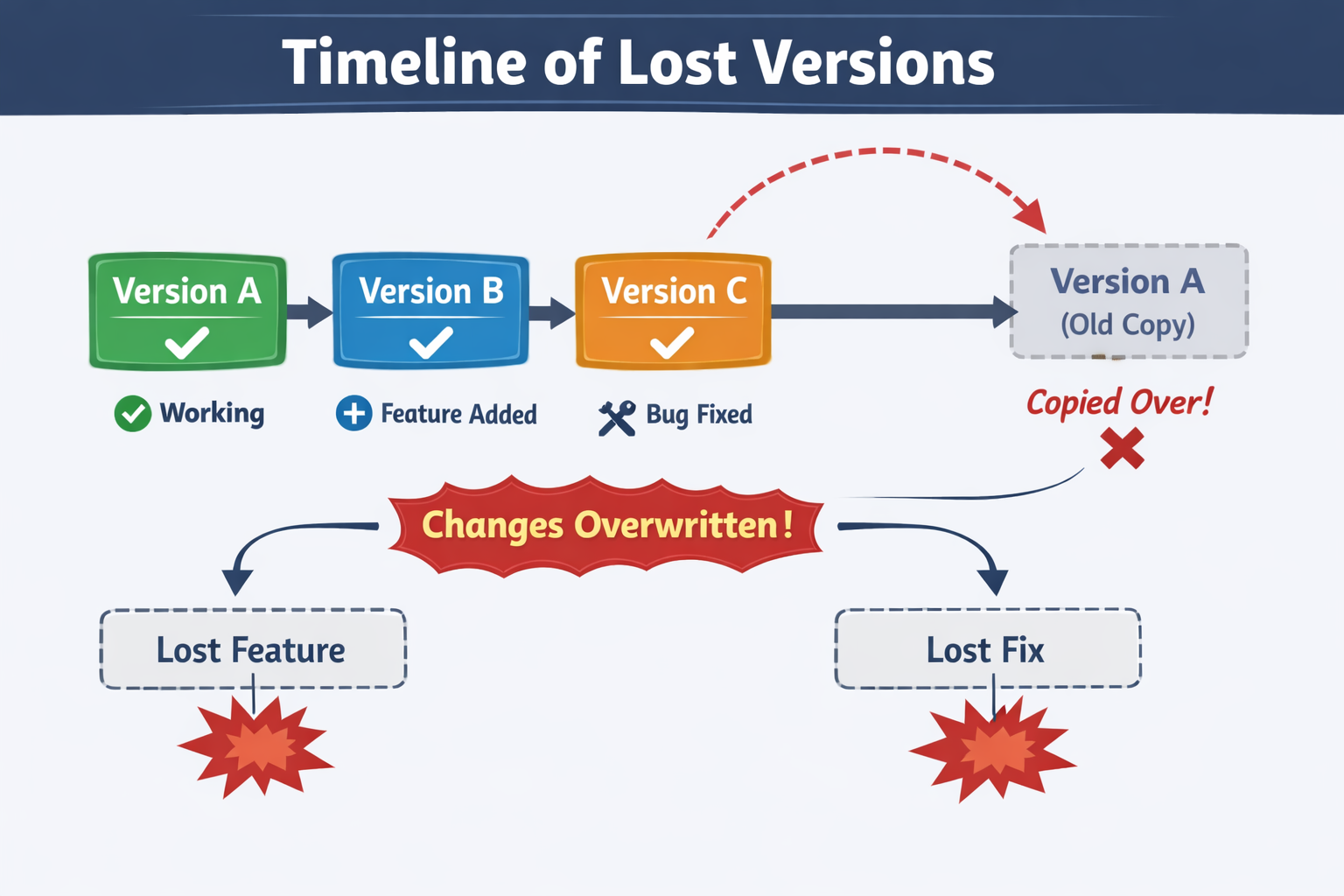
Here’s what usually happened:
Version A works
Version B adds a feature
Version C fixes a bug
Someone copies Version A again
Features and fixes are lost forever
There is no single source of truth.
6️⃣ Why Version Control Became Mandatory
Version Control Systems (VCS) solved all pendrive problems at once.
They introduced:
✅ A complete history of changes
✅ Safe collaboration
✅ Conflict detection instead of silent overwrites
✅ Easy rollback to any previous state
✅ Confidence to experiment
Instead of copying folders, developers started recording snapshots over time.
7️⃣ Pendrive Workflow vs Version Control Workflow
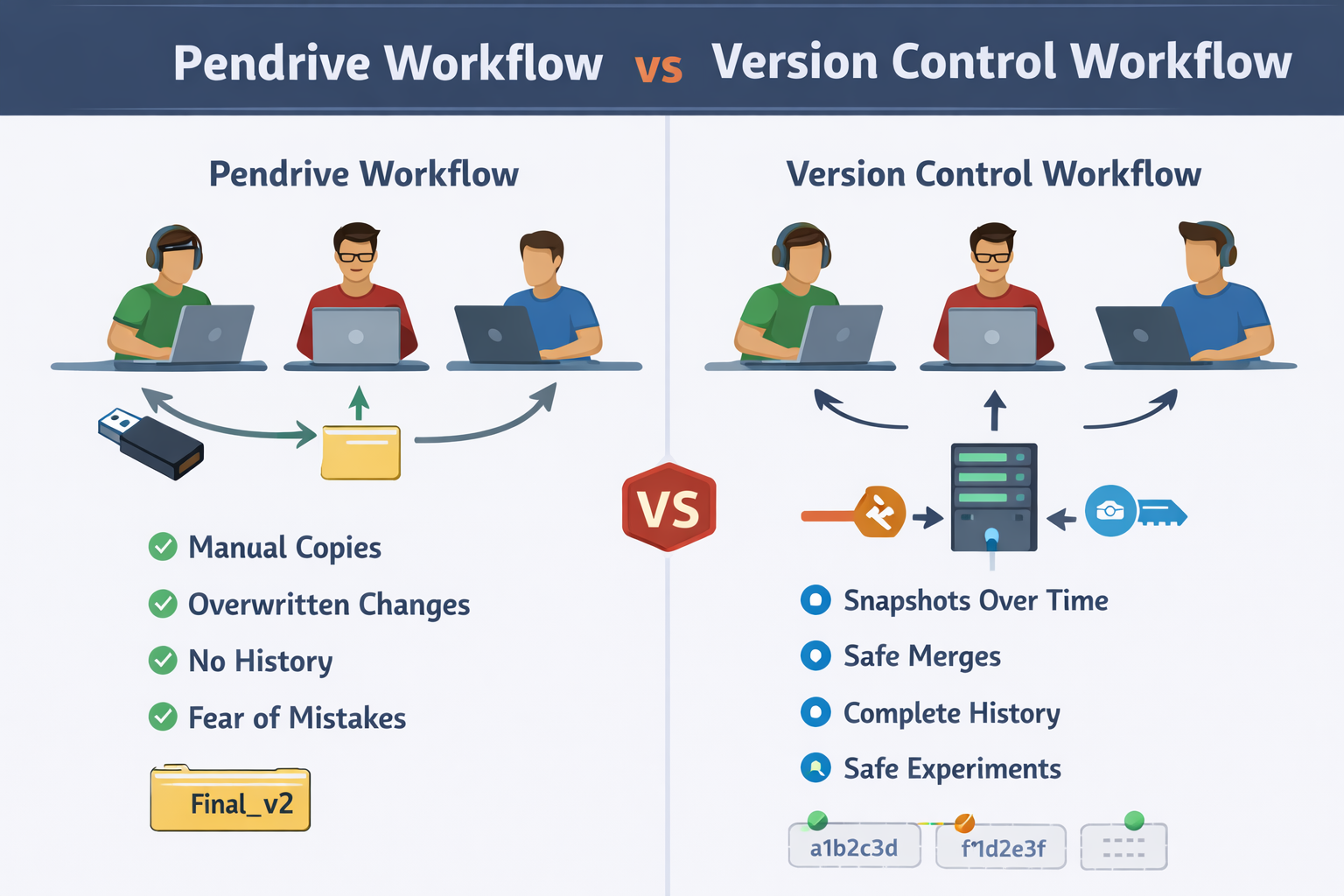
| Pendrive Workflow | Version Control Workflow |
| Manual copies | Automatic snapshots |
| No history | Complete timeline |
| Overwrites | Merge & conflict resolution |
| Fear of mistakes | Safe experimentation |
| No collaboration model | Built for teams |
8️⃣ The Big Mental Shift 🧠
Before Version Control
“Don’t touch that file, I’m working on it.”
After Version Control
“Make changes freely. We’ll merge safely.”
This single shift changed how software is built.
🔚 Conclusion: The Pendrive Had to Die
Version control didn’t appear because developers wanted fancy tools.
It appeared because:
Pendrives failed
Emails failed
Folder-based backups failed
Human memory failed
📌 Modern software development is impossible without version control.
Once teams, codebases, and complexity grew, version control became non-negotiable.